
Commerce and Industry Minister Piyush Goyal announced that an interim trade agreement between India and the US is likely to be signed in March and operationalised in April, with chief negotiators meeting in Washington to finalize the details.

The report evaluates the likely military, strategic and international fallout for China under scenarios ranging from a "major war" to a "minor conflict" with Taiwan, Focus Taiwan said.

In the Indo-Pacific's new era -- where perception shapes reality faster than treaties -- the real entrapment is not of China or the United States. It is the test Japan has set for itself -- and whether partners like India, acting as balancers rather than accelerants, can help ensure that the story ends in stability, points out Varun Arya.

The enduring relationship between the two countries have survived the disintegration of the erstwhile USSR in 1991, the end of the Cold War and the regime change in both countries, points out Rup Narayan Das.

The Russians have termed Putin's visit to India, his first to this country since the outbreak of the Russia-Ukraine war, as 'Druzhba Dosti', which means 'friendship' in Russian and Hindi respectively.
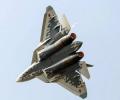
However, these are understood to be exploratory talks, with an agreement unlikely to be formalised during the current visit.
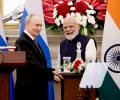
Russia, being bogged down by the Ukraine war and prioritising the requirements of its own armed forces, along with India's consistent diversification policy, will remain a major challenge to the bilateral partnership, note Harsh V Pant and Aleksei Zakharov.
What appeared to be a generous act of friendship was, in truth, a manoeuvre within a much larger strategic game. The United States used the 1962 war not just to aid India but to test how far it could be pulled into the Western fold, points out Dr Kumar.

China has made serious inroads into Latin America, which the US may now be hinting is simply not ok: Stay in your lane, Xi! In simple terms, China will no longer have access to Venezuelan oil, points out Rajeev Srinivasan.

Dhurandhar's most dangerous idea is that Director Aditya Dhar envisions an Indian state run by a deep state -- an intelligence machinery not accountable to Parliament, courts, or voters. A future political system where unelected officials decide when Indian democracy is 'fit' to function, observes Syed Firdaus Ashraf.

In the phone conversation on Tuesday, Singh urged Hegseth to expedite the delivery of GE F404 engines to power the Tejas Light Combat Aircraft, people familiar with the matter said.
Records stretching back to 1947 suggest a consistent strategy by Pakistan's military and intelligence apparatus, the Inter Services Intelligence (ISI), of using terrorism as a state policy against India.

China on Friday said the Shanghai Cooperation Organisation (SCO) summit to be held in Tianjin later this month will be the largest in the bloc's history, with 20 world leaders, including Prime Minister Narendra Modi, attending it.

After Operation Sindoor, the Army and Navy now view the IAF as not a supporting arm, but the spearhead of India's warfighting capability, capable of decisive outcomes across domains, explains Air Commodore Nitin Sathe (retd).
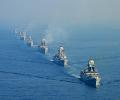
A parliamentary panel on external affairs has expressed concern over China's growing presence and influence in the Indian Ocean Region, citing risks to India's national security and strategic interests. The panel also highlighted the strengthening China-Pakistan naval nexus as a cause for concern.

'What we need to watch is how Saudi Arabia's financial assistance will be used by Pakistan. If the funds go to build their military hardware and operations, it should worry us.'
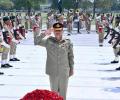
Sections in the US State Department and Pentagon have always felt more comfortable dealing with all powerful Pakistani generals instead of elected civilians, points out Rana Banerji, who headed the Pakistan desk at RA&W.

A preliminary investigation into the Air India Flight 171 crash in Ahmedabad reveals that both fuel switches were cut off before the crash, followed by pilot confusion. The report also indicates that fuel samples were satisfactory and no immediate action is recommended for Boeing 787-8 operators.
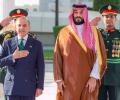
'Saudi-Pak defence pact is to anchor the defence and security of Saudi Arabia and not Pakistan, per se, with Islamabad being the junior partner.'

'However, we must implement a tit-for-tat approach -- reciprocating their conduct with precision.' 'If they demonstrate respect, we respond accordingly. If they adopt hostile positions, we mirror that hostility with equal intensity.'
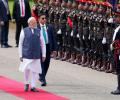
India's concerns over a planned naval exercise between Pakistan and Sri Lanka in the strategically important waters of Trincomalee led to the shelving of the drills weeks ago. The exercise was planned as part of regular engagements between the two navies, but India expressed its apprehensions to the Sri Lankan government. Trincomalee, situated on Sri Lanka's northeastern coast, is considered a significant hub in the Indian Ocean region, particularly for India's maritime security interests. The Pakistani Navy's close cooperation with China's PLA Navy has raised concerns in New Delhi about any Pakistani warship presence in Trincomalee. This incident follows previous diplomatic rows between India and Sri Lanka over the docking of Chinese vessels at Sri Lankan ports. India has been actively supporting Sri Lanka's development of Trincomalee's energy infrastructure and has recently signed a defense pact with the country to boost military cooperation.
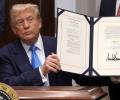
For India, the challenge is to strike a balance between tactical necessity and economic priorities, point out Pravin Krishna and Monil Sharma.
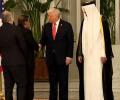
A Reuters report stated that the high-profile meeting reflects Ambani's growing influence in global business and diplomacy. Over the years, Qatar Investment Authority (QIA), the country's sovereign wealth fund, has invested in several Reliance ventures.

China appears determined to upgrade Pakistan's military capabilities, sufficient to ensure local parity with India, alerts former foreign secretary Ambassador Shyam Saran.
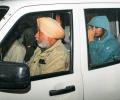
Modi will try to impress upon the Trump administration the importance of appreciating its sensitivities and political implications on the issue of deporting undocumented Indians in military aircraft.
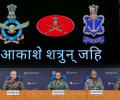
The Indian Air Force on Monday said all its military bases and systems continue to remain fully operational, and ready to undertake any further missions if the need arises.
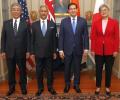
The Quad grouping has called for bringing the perpetrators, organisers and financiers of the Pahalgam terror attack to justice without any delay and urged UN member nations to extend cooperation for it.

While Bangalore based state-owned Hindustan Aeronautics Limited (HAL) will fork out $300 million, Russia's United Aircraft Cooperation (UAC) will invest a similar amount for the joint venture, which will start rolling out the aircraft by 2017.
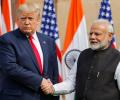
The China threat continues to resonate in the strategic partnership between India and the USA, points out Rup Narayan Das.
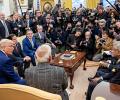
During the talks, India and the US decided to take a big leap in broad-basing their strategic ties in several critical areas.
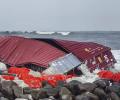
Containers from a Liberian cargo ship that sank off the Kerala coast have started washing ashore, prompting authorities to urge the public to stay away from them. The ship carried 13 hazardous cargos, including calcium carbide, which reacts with seawater to release highly flammable acetylene gas. The Indian Coast Guard is leading pollution response efforts and monitoring the spread of the oil slick.
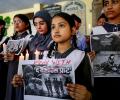
An Indian delegation met top officials of the United Nations Office of Counter-Terrorism (UNOCT) and Counter-Terrorism Committee Executive Directorate here even as New Delhi stepped up efforts to designate The Resistance Front, a Lashkar-e-Tayyaba proxy, as a UN-listed terror outfit for its alleged involvement in the Pahalgam attack.

Prime Minister Narendra Modi and French President Emmanuel Macron have called for enhancing trade and investment ties between their countries and committed to further deepening their engagement in the Indo-Pacific. They discussed a full spectrum of bilateral relations, including key global and regional issues, and stressed the urgent need for reform in the United Nations Security Council. The leaders also underscored their commitment to ensuring the global AI sector can drive positive social, economic, and environmental outcomes.
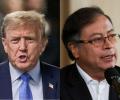
US President Donald Trump has imposed tariffs and a travel ban on Colombia after the South American nation refused to accept two American military planes deporting undocumented Colombians. The move comes after President Trump announced mass deportations of illegal immigrants and warned countries of consequences if they refuse to accept them. Colombian President Gustavo Petro, in a post on X, said that the US cannot treat Colombian migrants as criminals and denied the entry of American planes carrying Colombian migrants into Colombian territory. Trump responded by imposing a 25% tariff on all goods coming into the US, a travel ban and immediate visa revocations on Colombian government officials, and visa sanctions on all party members, family members and supporters of the Colombian government. The US also announced enhanced customs and border protection inspections of all Colombian nationals and cargo on national security grounds. In retaliation, Colombia announced a 25% import tariff on American products.
The deportation of 104 Indian nationals from the US, followed by another 119 set to arrive in Amritsar on Saturday night, has sparked controversy in India over the treatment of returnees. The US government's intensified crackdown on undocumented immigrants has led to criticism of the use of handcuffs and shackles for deportees, even those who have committed no crimes beyond immigration violations. The issue has led to heated debates in the Indian Parliament, with opposition leaders demanding an inquiry into the deportation process. The Indian government is engaging with US officials to ensure the humane treatment of deportees, while also facing the challenge of reintegrating returnees into Indian society. The deportations highlight the ongoing tension between border control and human rights, and the complexities of US-India relations.
The United States will deport 119 Indian nationals who were living in the country illegally. The individuals will arrive in Amritsar, India, on Saturday, hours after Prime Minister Narendra Modi asserted the need to combat human trafficking. This deportation follows the arrival of a US military aircraft carrying 104 illegal immigrants earlier this month. Prime Minister Modi and President Donald Trump discussed the issue of illegal immigration during their joint press conference, emphasizing the need to dismantle the "ecosystem" of human trafficking. Modi emphasized India's willingness to take back its citizens residing illegally in the US, and Foreign Secretary Vikram Misri confirmed that the issue of illegal immigration was raised during the discussions, stressing the need to address the root causes of the problem. India seeks cooperation from the US to dismantle the rackets and ecosystems that facilitate illegal immigration, potentially involving collaboration between law enforcement and intelligence agencies.
The Indian government does not track the number of undocumented Indian immigrants residing in the US. Minister of State for External Affairs Kirti Vardhan Singh, in a written response to a query in the Rajya Sabha, said these immigrants have "legally exited India" but have either overstayed their visa validity, or have entered the US illegally or without valid documents. The response comes at a time when Prime Minister Narendra Modi is on a two-day visit to the US, during which he will hold a bilateral meeting with President Trump. The two leaders are likely to discuss India-US cooperation in sectors like trade, investment, energy, defense, technology and immigration.

India has expressed concern to the US authorities over the treatment of deportees on a flight that landed on February 5, particularly with respect to the use of shackles, especially on women. The Ministry of External Affairs (MEA) has also registered its concerns regarding the need to accommodate the religious sensitivities and food preferences of the deportees. The US side has confirmed that no women or children were restrained on the deportation flights that landed in India on 15th and 16th February, 2025.

So far, 14 Rafale jets are operating in the IAF and the number will go up to 18 after the arrival of the new batch.
'If there is a military standoff eyeball to eyeball on the western border, the Chinese could create problems by making movements in the north, in our northeast, which could involve us tying down some forces there so that could stretch our military actions.'
